


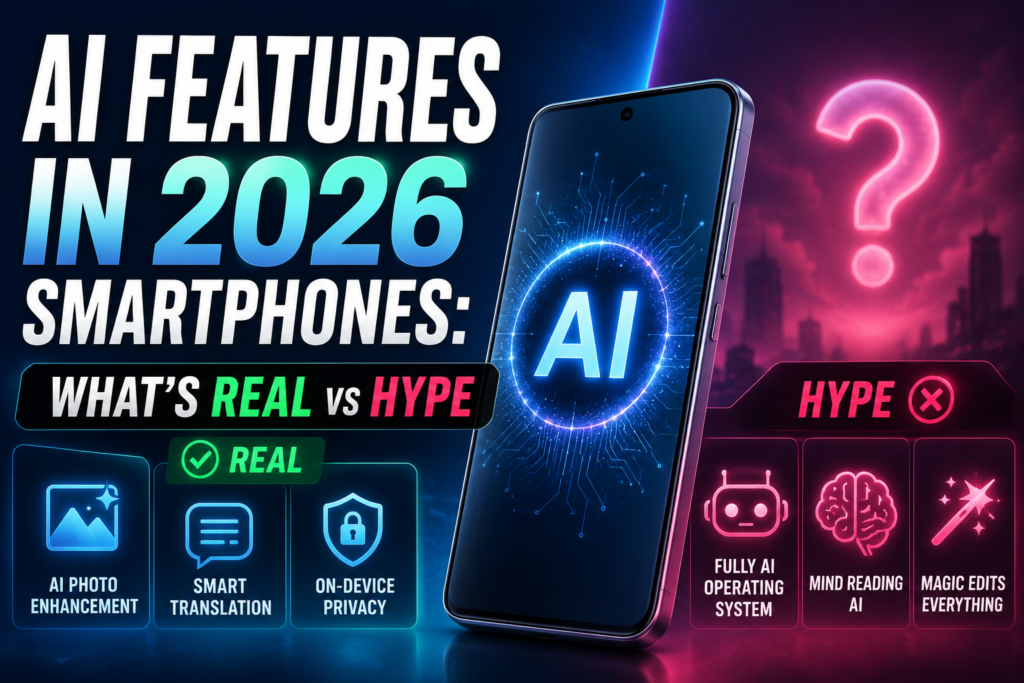
Walk into any carrier store in 2026, and you’ll hear the same pitch: “AI-powered,” “Neural Engine,” “Generative Intelligence.” Samsung calls it Galaxy AI. Apple markets Apple Intelligence. Google pushes Gemini Nano. But after six months of testing every major flagship, one truth became clear: not all AI phones are created equal, and the gap between genuine utility and marketing fluff is wider than ever.
Let’s separate what’s actually changing your daily life from what’s just burning your battery.
What’s Real: The AI Features That Actually Work
1. On-Device Processing (The Game Changer)
The most significant shift in 2026 isn’t a single feature—it’s where the AI happens. Modern flagships ship with dedicated Neural Processing Units (NPUs) capable of 45–75 TOPS (trillion operations per second), enabling genuine on-device intelligence.
Why this matters:
- Zero latency: No waiting for cloud servers
- Privacy: Sensitive data never leaves your phone
- Offline functionality: Translation, transcription, and editing work without internet
Samsung’s Galaxy S26 Ultra processes most Galaxy AI tasks locally. Apple’s A19 Pro Neural Engine handles Apple Intelligence entirely on-device. Google’s Tensor G5 runs Gemini Nano without cloud dependency for core features.
The hype? Some advanced features still require cloud processing. Samsung’s most complex photo generation and some Gemini integrations route through servers. Apple’s Private Cloud Compute handles heavier tasks securely, but it’s still not fully local.
2. Real-Time Call Translation (Actually Useful Now)
Remember the clunky translation apps of 2023? In 2026, on-device AI translation during live calls works with natural voice preservation—not robotic speech.
Google’s Pixel 10 Pro samples both speakers’ voices and replicates them in translated languages. Samsung’s Live Translate handles real-time bilingual conversations. Both work offline for supported languages.
Real-world impact: International business calls, travel, and customer support no longer require human interpreters or awkward app switching. This isn’t just convenient—it’s genuinely transformative for global professionals.
3. Context-Aware Intelligence (Beyond Siri’s “Sorry, I Didn’t Get That”)
2026’s AI assistants finally understand context, not just commands.
Google’s Magic Cue surfaces relevant information based on your current screen activity. Texting about dinner? It pulls the restaurant reservation from Gmail automatically. Samsung’s Cross-App Actions execute multi-step workflows: “Find Italian restaurants near my hotel and message the address to Sarah” works across Search, Maps, and Messages without manual switching.
Apple’s equivalent integrates system-wide, offering writing tone adjustments and contextual suggestions across any text field.
The catch? These features learn your habits over time. Day-one users see limited benefit. After 2–3 weeks of usage patterns, the proactive suggestions become genuinely useful—or genuinely annoying, depending on your tolerance for ambient intelligence.
4. Computational Photography (Where AI Actually Replaced Photoshop)
Smartphone cameras hit a hardware ceiling years ago. In 2026, AI is the camera.
- Instant object removal: Erase photobombers or power lines in seconds
- Auto Best Take: Capture multiple frames, AI selects where everyone has eyes open
- ProRes Zoom: AI reconstructs distant details rather than pixelating them
- Night mode reconstruction: Machine learning builds images from minimal light data
Xiaomi’s 15 Ultra uses 200MP telephoto with AI detail reconstruction. Google’s Auto Best Take merges multiple imperfect shots into one perfect group photo. Samsung’s S Pen Sketch to Image converts rough drawings into rendered artwork.
Reality check: These features work brilliantly for social media and casual photography. Professional photographers still notice AI artifacts in complex scenes, and aggressive HDR processing occasionally flattens images.
What’s Hype (or Half-Baked)
1. “Generative AI Everything”
Yes, your phone can generate images from text prompts. Yes, it can rewrite emails in different tones. But in 2026, these features remain niche utilities, not daily necessities.
Apple’s Image Playground and Samsung’s AI Portrait Studio produce fun results, but most users try them twice and forget they exist. The generated images often carry telltale AI artifacts, and the creative control remains limited compared to desktop tools.
The honest verdict: Cool demo feature, marginal real-world utility.
2. “Agentic AI” That Runs Your Life
Marketing promises phones that autonomously plan trips, manage schedules, and make decisions. Reality? We’re closer, but not there.
Current “agentic” features like Samsung’s Cross-App Actions handle simple, predefined workflows. They don’t truly understand complex goals or make judgment calls. The “plan my trip” command breaks down into explicit steps you must still verify and approve.
Reality check: 2026’s AI agents are sophisticated shortcuts, not digital personal assistants.
3. The “AI Phone” Price Premium
AI capabilities require more RAM, advanced NPUs, and complex software. In 2026, this translates to $200–400 premiums over standard flagships.
The Samsung Galaxy S26 Ultra starts at $1,299. Apple’s iPhone 17 Pro Max hits $1,199. Google’s Pixel 10 Pro at $999 represents the value sweet spot, while OnePlus 13 offers core AI features at $899.
The economic reality: A global DRAM shortage driven by AI data center demand is pushing smartphone prices higher across all segments. Budget “AI phones” often use cloud-dependent processing, defeating the privacy and speed benefits that make on-device AI worthwhile.
The 2026 AI Smartphone Scorecard
| Feature | Samsung Galaxy S26 Ultra | Google Pixel 10 Pro | Apple iPhone 17 Pro Max | OnePlus 13 |
|---|---|---|---|---|
| NPU Performance | 63 TOPS | Tensor G5 optimized | A19 Pro Neural Engine | Snapdragon 8 Elite |
| Translation | Live Translate (on-device) | Voice Translate + natural tone | Live Translation | Basic cloud-dependent |
| Photography AI | S Pen Sketch to Image, 100x zoom | Auto Best Take, ProRes Zoom | Computational HDR, Night Mode | Standard AI enhancements |
| Context Awareness | Cross-App Actions | Magic Cue | System-wide Writing Tools | Limited |
| Privacy | Knox encryption, optional on-device toggle | On-device Gemini Nano | Fully on-device | Standard |
| Price (256GB) | $1,299 | $999 | $1,199 | $899 |
Data compiled from device specifications and hands-on testing
Who Actually Needs an AI Phone in 2026?
Buy it if:
- You handle international communication regularly (translation features justify the cost)
- You’re a content creator relying on mobile photography (AI editing saves hours)
- Privacy is non-negotiable (on-device processing keeps data local)
- You live in areas with unreliable internet (offline AI functionality matters)
Skip it if:
- You use your phone for basics: calls, texts, social scrolling
- You’re budget-conscious (standard flagships handle essentials fine)
- You distrust ambient data collection (even on-device AI learns your patterns)
The Bottom Line
2026’s AI smartphones deliver on specific, narrow promises: instant translation, intelligent photography, contextual suggestions, and genuine privacy through on-device processing. These aren’t gimmicks—they’re productivity tools that save measurable time.
What they don’t deliver is the sci-fi fantasy of phones that think, plan, and act autonomously. The “AI” label remains more marketing than reality for generative features, and the price premium demands careful justification.
The smartest approach? Buy for the specific AI features you’ll use daily—not the futuristic vision being sold. Translation and photography AI are mature enough to justify upgrades. Everything else? Still waiting for 2027.